
The fastest way to ruin something in fashion right now is to call it a microtrend.
Calling neck scarves a “microtrend” may not be wrong in theory– but in practice, it’s how we take something elegant, intuitive, and personal, and turn it into a performance everyone gets tired of watching.
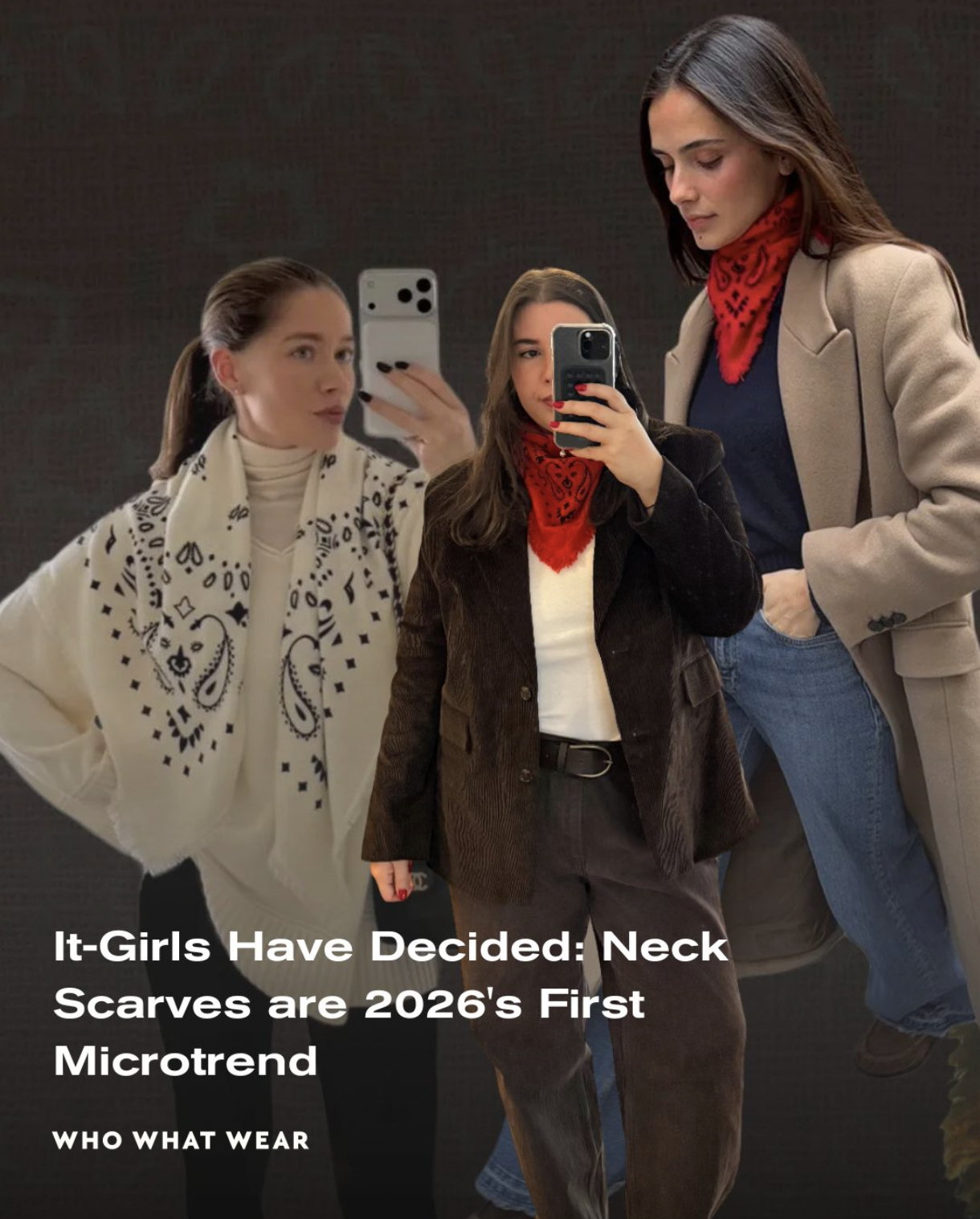
This article was sparked by a recent Who What Wear post labeling neck scarves as the first microtrend of 2026. And I’ll be honest, it annoyed me. Not because scarves don’t deserve attention, but because framing them this way almost guarantees what comes next: overexposure, backlash, and eventually, the inevitable “cheugy” label once everyone is wearing one.
Earlier coverage from my platform framed scarves as an accessory moment as early as February 2025, not because they were new, but because of how versatile and personal they are. That piece focused on range: around the neck, on the head, tied at the waist, draped over the shoulders, styled differently depending on the outfit and the person.
The image that sparked this article did the opposite. Nearly identical models (no hate to them, they look super stylish and cool!!), in nearly identical scarves, and nearly identical styling logic. Two tied in an identical triangular, cowboy-style knot at the front. One draped over the shoulders. Minimal variation, maximum uniformity. It read less like inspiration and more like instruction, and that’s exactly the problem.
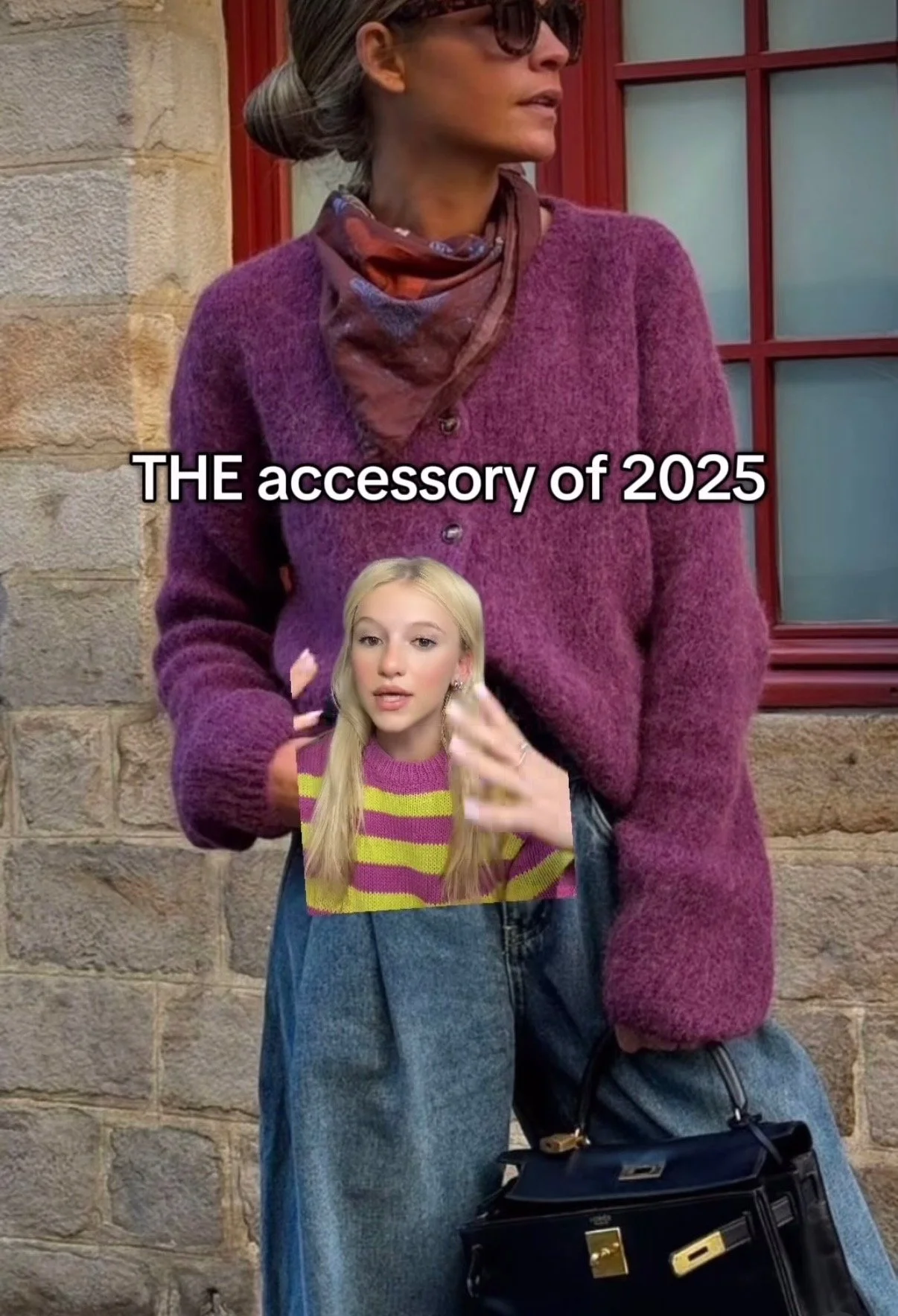
When language controls taste
Trend language used to describe what was happening. Now it directs it.
The moment an item gets labeled a microtrend, an expiration date is quietly attached. People don’t ask whether they like it or how it fits into their lives– they ask whether they’re early, late, or already behind.
Taste shifts from instinct to strategy. Style becomes less about expression and more about positioning. And that’s exhausting.
Microtrends turn style into execution
A microtrend doesn’t invite interpretation; it invites replication.
Instead of styling something intuitively, people look for the “right” way to wear it. The version that’s been approved by the internet. The one that signals trend literacy instead of personal taste.
That’s when fashion flattens. Not because too many people are participating, but because everyone is participating in the same way.
When trend imagery shows multiple people wearing the same item in nearly identical ways, it doesn’t encourage creativity, it creates a template. Follow this. Wear it like this. Look like this.
And once style becomes execution, burnout isn’t far behind.
Accessibility isn’t the issue, uniformity is
It’s easy to blame accessibility. To say that once something is available to everyone, it loses its appeal. But accessibility isn’t the problem; uniformity is.
When an item becomes widely available and narrowly defined, creativity disappears. The piece stops evolving and starts repeating itself. Overexposure follows, and then comes the backlash.
We don’t get tired of the item. We get tired of seeing it worn without thought.
The self-fulfilling prophecy
Microtrend framing creates the exact outcome it predicts. Fast adoption leads to simplified styling. Simplified styling leads to overexposure. Overexposure leads to collective burnout.
And when that burnout happens, we don’t question the system. We declare the item “over” and move on.
The cycle speeds up. The timelines get shorter. The fatigue gets louder.
What actually lasts
The things that survive aren’t protected from popularity; they’re protected by taste.
They’re the pieces that allow for nuance. That look better when styled differently, on different people, in different contexts. The ones that don’t need instruction manuals.
The people who wear scarves well won’t stop wearing them because of a headline. They’ll just stop wearing them obviously. They’ll move away from the hyper-visible, hyper-instructed version and return to styling them intuitively.
That quiet shift is how real style endures.
A better question
Maybe the problem isn’t whether something qualifies as a microtrend.
Maybe the better question is who benefits from labeling it that way.
Because fashion doesn’t need more countdown clocks. It needs more space for instinct, intention, and personal context.
The problem isn’t that trends move fast– it’s that we’re told to wear them all the same.